16 Nov 2011

La Jetée


Year: 1962
Director: Chris Marker
Length: 28mins

Chris Marker is a french writer, photographer, artist, film essayist and- of course- film director. he was born in 1921. still alive.

Little is known on marker's early life. Most people known is that Alain Resnais brought Marker to film marking with three years collaboration, Before making film he was a journalist.

Majority film work of Christ Marker are documentary. And this film, La Jetee is one of his a few fiction film and also the famous one. La jetee is important key film of Left bank film movement.

So, what is Left Bank Film?

Left bank is a subgroup of the french new wave film movement, as a kind of intellectual, political, feminist, literary, aesthetic and avant- garde wing of new wave. the two groups aren't opposite, instead they are friends, cooperators and allies.

Left bank main members are: Alain Resnais, Chris Maker, Agnes Varda and Jacques Demy. 

And how about this film, and what is the story ?

La jetee is about time travelling, a science fiction film. It was constructed entirely by thousands  black and white still picture. the background set on the postwar and destroyed city -Paris, the main character is a prison who has a strong children time memory about a man be killed in the airport (la jetee), and he is sent to past, in the old times he meets a girl  and falls in love with her... he tries to escape from the present world, and is chased and shoot by the agent from present. Finally, he realise he is the man who be killed in his memory.

social and political issue:
you can say La Jetee is an anti-war film, because it shows the ruins of Paris. in this film.

contrast:
present- the post apocalyptic city, people only live in the dark underground, where is full of the white noise: like generator and radio wave sound.

past- before destroying, the upper ground world is sunshine and bright. the background sound is people, animal natural sound.       
     
museum/ gallery : survivors dwell in underground of Palais de Chaillot galleries. when the main role comes back to the past, he go to date a girl in the museum.

aesthetic:
Chris Marker is also known as photographer, that's easy to understand why he can take stunning pictures to compose this classic film, you can see almost all the still images are well-designed, like a poem.


13 Nov 2011

Ways of Seeing / John Berger - Ch.1 reading notes


In the beginning of the article, the writer states that the ways of how we see is an act of choice, is affected by our belief and knowledge. We are always looking at the relation between things and ourselves, and what was relative to your position in time and space.

When an image is seen as a work of art, beholders may consider about its myth, authenticity, market value and also the assumptions of art, i.e. beauty, truth, genius, civilization, form, status, taste. However, these assumptions change their meanings time by time. That may cause the primal and first relation losing between the image and experience of beholders and lead to culture mystification of the past.

In the early Renaissance, the convention of perspective was established. This convention puts the eyes of the spectator in the centre of the visible world. In addition, it seems that the whole visible world is arranged for the spectator.

After the camera was invented, this concept was challenged, this invention proves and demonstrates the centre of the visible world is not exist. The meaning of seeing is changed, and that conversion was reflected in painting. Different views were depicted in the one piece of artwork.

The invention of camera also destroyed the uniqueness of work of art, and the paintings can be reproduced. Moreover, these reproductions are been given new meanings through the their different and new purposes and sequence of viewing.

Reproduction also be seen as kind of information, it travels and its meaning is also diversified.

The meaning of original work is no longer depended on what it says, but on what it is. Therefore, the original artwork maintains its own authority.

10 May 2011

My own project- Last Twenties

theme: what people did in their 30.

i am in my late twenties, feel kinda confused and anxious about being nothing, try to know and collect what other people did in their 30, also practice my portait drawing skill.

William Burroughs, in his 30 (1944), began shared apartmant with Jack Kerouac, and started collaborated novel called "And the Hippos Were Boiled in Their Tanks" .
 J. D. Salinger, in his 30 (1949), one of his early work "Uncle Wiggily in Connecticut" adapted into a film called "My Foolish Heart".

Jarvis Cocker, during his 30 (1993), he and other members of Pulp recorded their forth album" His 'n' Hers "

22 Mar 2011

My Primary Needs - Part2


dotted notes


eighth note /quaver


22 Feb 2011

My Primary Needs -Part1


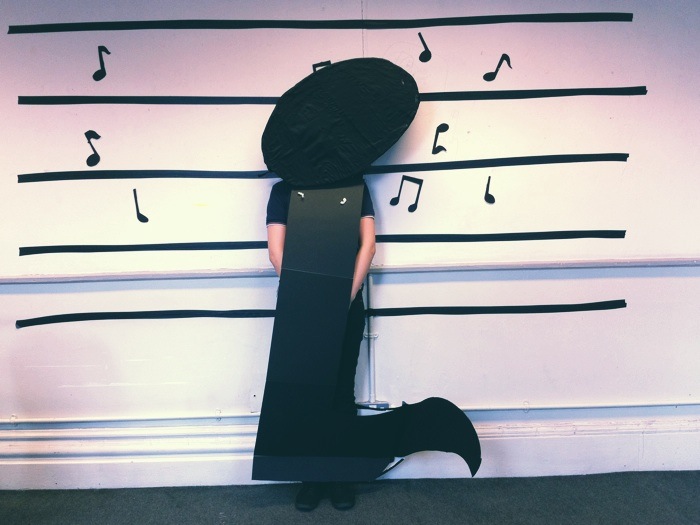
This project started from our own primary needs, including mental and phsical ones. And my own basic needs are freedom, family and friends, music ( indie rock), creative (drawing) and self esteen. my costume is came from music. i made a music-note clothing with big head. 


23 Nov 2010

Step out of London, to Cambridge

Today, Darryl (Course Director) take us, who didn't join the trip to Budapest, to Cambridge. Frankly speaking, i have never been out of London, including the period of my foundation days. So, i'm kinda exciting about that.

We gather in front of college around 10. By the way, the amount of staying-in-London students is bigger than i though. Then get in the coach, start our one day journey. it takes approximately one and half hours to Cambridge. The first place we are going to visit is Kettle's Yard.          

We arrive Cambridge about 11:30, and the current exhibition of Kettle's Yard garllery is AS SO CI ATIONS. The title comes from John Smith's film "Associations", 1975. Fellowing is its introduction taken from John Smith official website

Images from magazines and colour supplements accompany a spoken text taken from ‘Word Associations and Linguistic Theory’ by Herbert H Clark.  By using the ambiguities inherent in the English language, Associations sets language against itself.  Image and word work together/against each other to destroy/create meaning.
"Associations is a straightforward rebus (a game in which words are replaced by pictures).  But the text is so dense (contemporary linguistic theory) and the combination of visual puns so extensive that a simple, unique reading of the film is impossible."  
A.L. Rees, Unpacking 7 Films programme notes.


This Artist's other work"The Girl Chewing Gum" is included as well. i have watched this film 4 years ago. Roughly, It films on a busy street corner, and a voice seems to direct the action commandingly , but actually it is just a narrator descibeing what happened in front of the him. 

Other works of this exhibition show how the artists (including Marcel Broodthaers, Pavel Bühler, Matthew Buckingham, Sharon Hayes, Michael Snow ) rearrange the words, the images and its meanings, focus on the relationship between language and history. Majority of these works i quiet enjoyed. However, i seriously consider how to improve my language level. (sigh)

After lunch, we go and visit the house of Kettle's Yard. Kettle's Yard is fomer house of Jim and Helen Ede. Jim was a curator at the Tate  Gallery during 1920s and 1930s. After retiring from the Tate in 1936, Mr. and Mrs. Ede travelled all around the world, due to above-mentioned two reasons, they got not a small amount of art collections. They searched a suitable place to live in and display the art works they owned as well. They found a area, consisted from four small and  dilapidated houses, known as "Kettle's Yard" locally. And Jim designed all the space and rooms, and display their  exquisite collections in it. The couple had lived here for16 years, from 1957 to1973. After many times of extensions , the scale of Kettle's Yard is what we see today. It divides into two parts, one is gallery( where the exhibition is ), the other is House. 


The House only open 2 hours per day ( 2pm ~ 4pm every Tuesday to Sunday). It is very worth to visit, you can find creativities, stimulus and inspirations in all of these rooms, just in the corner, the space, paintings, sculptures, books, furnitures, contemporary artworks, even the light and others objects. I really really like this house, truly provoke thinking. So adorable. They mix different kinds of styles perfectly. Really, i want to live in !


After this lovely house, we walk to the museum called The Fitzwilliam Museum, its scale is bigger than Kettle's Yard, the collections is a little similar to the British Museum ones, antiquities of Egyptian, Greek and Roman, sculptures, but one biggest difference is the former has a huge number of paintings.

We finish the visiting of The Fitzwilliam Museum in a hurry, coz have to catch the coach back to London. And 2 hours later, the Cambridge one day trip ends in front of college, where we get off the coach, with a great mood and satisfaction.


12 Nov 2010

Barnaby Barford

Salads? I'll give them fucking salads! 


We have a "Visiting Practitioner Talk" every Wednesday, from beginning to now, we had Tom Guald ( a cartoonist and illustrator, his drawings are simple and concise, can be seen in many publications) , Alice Stevenson ( an illustrator and surface pattern designer, work for Marc Jacobs, Hugo Boss and etc ), James Jarvis ( very famous illustrator and toy designer, i have already seen some of his work before, maybe 10 years ago, not sure), and my favourite one - Barnaby Barford ,who is an artist and filmmaker use the ceramic medium to create narrative scenes , most of time, these scenes are very satire.

The Reason why i enjoyed this lecture is not only his witty work but also his inspiring presentation. His work doesn't relative to illustration directly, But these images appear to tell stories in strong and humourous way. In other words, he make an illustration with these 3 dimensional objects.   

Wait until I get home, they're going to go crazy!

The way Barford work is reproducing the porcelain figures which are purchased from mass markets and antique shops. Cutting them, exchanging the part of them, and also repainting them. To be honest, i really cant tell these figures are assembly and remade :P

At least I'm still here
The stories he tell is reflective of current affairs, for instant, alcohol and teen drinking, teen gangsters and guns, celebrity culture, fast food globalization, and so on. Very irony but true.

Shortly After the Marriage (1743) by William Hogarth(1697-1764)
In this talk, Barford mentioned Hogarth, Chaucer, Dickens and Shakespeare as his inspirations, and displayed some paintings from Hogarth, these  compositions are dramatical and powerful. And Dickens and Shakespeare are well-known geniuses at using words to describe people and affairs in that periods. All of these masters' works have something in common, that are telling stories brilliantly and responding to the era they lived in. So, it is easy to understand why the scenes that Barford created are narrative and closing to everyone.      


Barford showed us other three film clips as well, two of them are masterpieces from Jan Svankmajer, i have seen them before.(By the way, Jan Svankmajer is an original creator and pioneer undoubtedly) ,and the other one is so ridiculous funny, Please search "Nigella XXXMAS" on youtube. i won't put that thing in my blog XD


Final, here is Barford's film called "Damaged Goods" , that is an 100% love story, looks like a tragic romance, but its ending is quite happy. ( Just click the title, it would link to the page)